
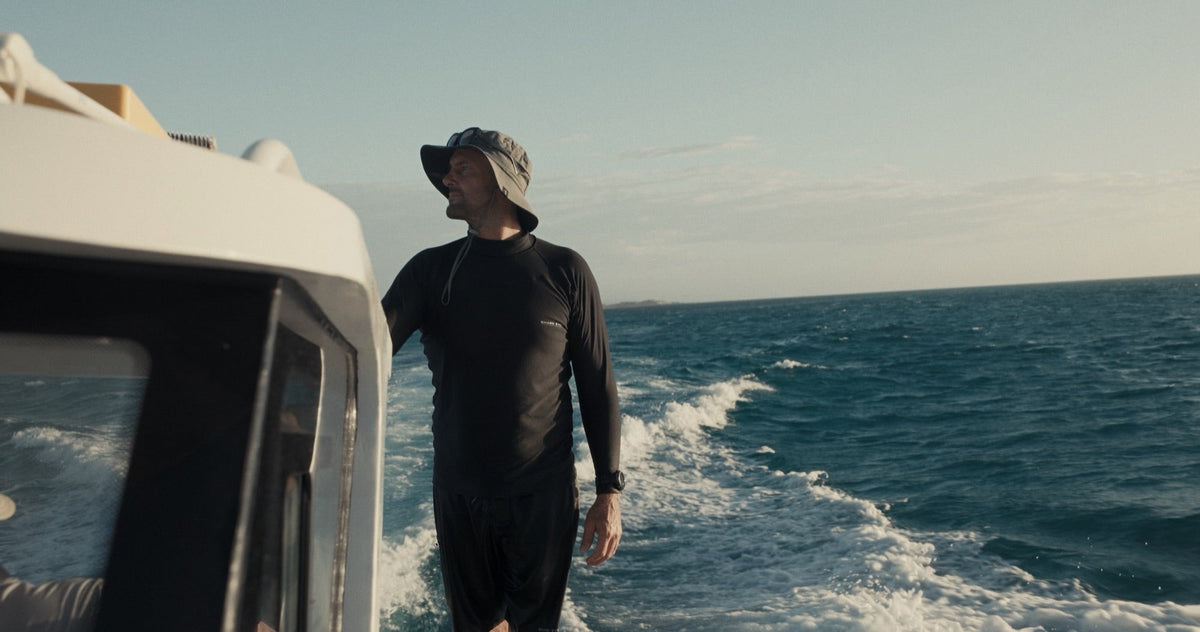
- by Shark Eyes
He Helped Save His Mate From a Great White. Then He Built Shark Eyes.
- by Shark Eyes
Shanan Worrall was on his first dive of the day, 15 metres down off Poison Creek, when the air hose started yanking. He surfaced to hear that a diver on the boat a couple of hundred metres away had been hit by a shark. There was no helicopter coming. What followed was an improvised rescue across 150 kilometres of beach, four wheel drive track and bitumen, and it is the reason Shark Eyes exists.
In September 2026 Shanan sat down with Dan O'Connell on the Everything Ocean Podcast for Shark Chat 5: 67 minutes on growing up in Esperance, the 2013 great white attack on abalone diver Greg Pickering, the long stretch when he could not get back in the water, and how a set of silicone eyes glued to a wetsuit became a non invasive shark deterrent. Every quote below is word for word from that episode; all but one are Shanan's.
In short
Shanan, now 47, was born and raised in Esperance on WA's south coast, near the Great Australian Bight. He left school at 15 and by 16 had bought his own boat.
"At 16 I bought like a 21-foot boat with twin 85s on it. And so I didn't have my license and my dad used to ... just say, don't go too far, you know. And so there's like 280, you know, islands and outcrops in the Esperance Archipelago. So I was with my 15-year-old mate and hammers were down and we were just out and amongst it."
Fishing, spearing, scuba, shell collecting and surfing all ran together. He still holds a specimen shell licence today. By 16 or 17 he was diving commercially for abalone, and a few years later he was working the deeper green lip and brown lip beds in up to 30 metres of water.
His first great white came at 15, off a tractor tube he had paddled out to an island in Duke of Orleans Bay.
"There was like a gray wall in front of me. And I was just like, what the heck's that? You know, your eyes are coming out of the bubbles, you know, with your mask on. And then I've, I've panned both ways and I still couldn't fit this thing in."
He is blunt about how rare that is, even for a commercial diver.
"I think every time you see one of those things underwater, you know where it was, you remember the dive, you remember the place. Um, they're a very different animal than every other shark."
This section describes a serious shark attack injury. Greg survived and still dives today.
October 2013. Shanan and his dive partner Andrew Rowe were camped at Poison Creek, about 150 kilometres east of Esperance, launching a 25 foot Shark Cat off the beach with a tractor and living out of caravans for a month or two at a time. Greg Pickering, a South Australian based abalone diver Shanan describes as a legend of the spearfishing world, had pulled up alongside and set up camp to dive the same ground.
That morning the boats were sitting a couple of hundred metres apart in open water, about 15 metres deep, 15 to 20 kilometres up the coast towards Cape Arid. Abalone divers there use hookah gear: a compressor on the boat feeding air down a line, a weighted lead vest to spread the load, and a small pony bottle on the back of the vest as a backup if the air supply is cut. Shanan was on his first dive of the day when Andrew started yanking the hose.
"As soon as I've hit the deck, Andrew's gone, oh, look, Greg's been hit by a shark. And I guess your heart sinks a little bit at that stage, but you're probably just thinking it's a bronzy, um, or bronze whaler shark, you know, or you're thinking it's probably something quite small."
They called the abalone factory on the sat phone hoping a mate's helicopter could fly Greg out. It was unavailable. The two boats ran back to the bay where they had launched, and Shanan climbed aboard Greg's boat, where his 19 year old deckie Callum was alone with him.
"There's blood everywhere. Looked at Callum's face. Callum's just white. And then walked up the front of the boat and saw Greg. And it was just, yeah, it was horrific."
It was not a bronze whaler.
"He'd actually been engulfed. He was down on the bottom and this thing, a white engulfed him head first up to like his waist. And the only reason that he wasn't in two pieces was because of that apparatus. I think I mentioned earlier with the lead vests and the canister on the back and this thing, it chomped on him, but it hadn't broken through."
Greg's air line had been cut in 15 metres of water. Somehow he got out of the shark's mouth, surfaced and got himself onto the boat.
The ambulance was coming from Esperance: an hour and a half of bitumen, then an hour of four wheel drive track that it could not drive. Shanan, Andrew and Callum would have to bring Greg to it.
"There we are with two 25 foot boats, three people, tractors on a, you know, beach launch and just going, okay, logistically, this is a pretty ... place to be."
Greg looked too badly hurt to lift, so they left him in the boat, hauled it up the beach with the tractor and stopped at the camp for sleeping bags and pillows to pad him. Then a piece of dive kit that turned out to matter: the oxygen bottle divers use to decompress after a deep dive.
"It was Greg that actually, um, I remember him like just gurgling out going oxygen because that, I don't think it came to my mind, um, to actually get that straight away."
Shanan rode in the back of the boat on the trailer for the hour down the track, pressing on the wounds.
"He had a big wound on his back and the rest of it, big things on his neck and that just trying to hold him together, telling him it was going to be okay when, uh, it was probably, you probably thought he was going to die, you know?"
Greg made it. He was flown to Perth, and in Shanan's telling the story has the ending nobody on that beach expected.
"He's in one piece and the crazy, crazy kid's still ab diving."

Five days before Poison Creek, Shanan had his own close call with a white. Another ab diver living with him had just come off one too. After Greg, he was done.
"I went and hit a bottle of red, pulled the blind shut for a couple of days."
He had planned to dive abalone in Esperance for the rest of his life. Instead he tried to get back in the water and found his body would not let him.
"I tried to get back in the water in Esperance, put my board under my hand and, you know, got out to my knees, Esperance, crystal clear water, sand, and I just started throwing up."
"I forced the issue paddled out the next day after that of trying to get back in the water. Um, just sat out the back throwing up and started crying and I'd, that's when I was like, I'm out. I'm, I'm moving town. I don't care if I'd never surf again."
He followed Heather, now his wife, to Margaret River. The first time he worked up the courage to get back in, for crayfish in the rock pools at Ellensbrook, people were walking up the beach with news.
"Saying, oh, someone's been hit up at Umbies. And that's where my brothers, uh, all of my mates, you know, it's like, okay, who's this, who's it going to be? You know what I mean? And it turned out to be, um, yeah, good mate of mine that I'd done a lot with, um, him and his brother over the years, uh, Chris Boyd."
Chris Boyd was killed by a shark at Umbies, near Gracetown, on 23 November 2013, six weeks after Poison Creek. Shanan took it as a sign and stayed out of the water.
He is open about needing help to get through it, and about still working at it.
"I think it is healthy at some stage just to go, Hey, I do need a bit of help here. I am busted, get the tools and then try to, try to implement them."
"I've learned a lot through the whole process and I'm grateful for all the experiences because, um, I wouldn't be half, you know, half where I am unless it was from those things."
What got Shanan back in the water was shells. His specimen shell licence is one of a limited number in WA, and he was not ready to give it up. So the question became how to make himself safer, and the answer came from years of watching sharks behave.
"One thing that we'd always seen when we had interactions with sharks was they'd always close distance from behind you. And then like most apex predators, they want the element of surprise and they want them to creep up. Whereas as soon as you actually have that line of sight, it changed their behavior. And I'd noticed that with sharks. I was like, okay, let's, I want eyes on the back of my wetsuit."
Heather found him in the shed doing exactly that.
"My wife came out, and she's kind of gone, what are you, what the heck are you doing? You know, silicone big eyes on your wetsuits. And I was like, told her a little bit of what we'd seen with sharks. And she was like, you've got to, does anyone know this or not?"
His sister, a PhD marine scientist, was the first person he asked whether there was any science behind it. The answer was a body of work on eye spots, biomimicry and predator behaviour, covered below.
The first Shark Eyes were launched on Tim Bonython's big wave film tour, where Shanan was guest speaking after winning a WSL Big Wave Award for a tube in 2017. He did not want to sell them.
"With sticker in hand, I was just wanting to give them to everyone. I didn't, you know, I didn't, couldn't, didn't want to take money. I was just wanting to, it was like, look, get them on your surfboards."
Giving them away was not sustainable, and approaches to government and fisheries bodies went nowhere.
"If we actually want to make a bit of a difference in this space, we have to commercialize and self-fund everything on the way through. So then it became more about going, okay, let's get a business hat on here."
Today the deterrent side is a small part of the business. Most of Shark Eyes is wetsuits, dive and surf gear, and apparel that fund the shark work.
"The shark deterrent side of the business is maybe 20% of the business or, you know, less. Um, whereas everything else is just, my passion is in crossing over those, I guess my surf knowledge and dive knowledge into good wetsuits."
The idea behind a Shark Eyes shark deterrent is not that a shark is scared of eyes. It is that an ambush predator makes a risk assessment before it commits, and being seen changes the answer. Shanan explains it with a lion.
"They don't just walk across a field blindly and just try to smash the zebra. You know, they, they're down, they skulk, they skulk. And then if they get close enough without being detected, then it's on. But if the zebra detects the lion from distance ... the risk assessment of the apex predator, in this case, the lion goes, okay, this thing has seen me from distance ... Generally, if it sees it, it gives up, you know, it's either on or it'll give up and look for another target."
Spearfishers see the same thing every day with fish: you cannot get close to anything that thinks it is being hunted. Surfers rarely see it because they are on the surface, which is exactly where the eyes on a board or a wetsuit are meant to do the work.
"To one ton of animal, it's not stopping once it's made its mind up, um, to divert an attack. But if it can, if you can trick it into making its own risk assessment, that it no longer fits into that risk assessment criteria and instinctively changes, I believe that could be the only thing that stops a big animal is its instinct itself."
That is the distinction from electronic deterrents, which as Dan pointed out in the episode need the shark to be within a metre or two of the device before they do anything. A visual deterrent is aimed earlier, at the moment the shark decides whether to come in at all.
"I think apex predators are all heavily reliant on the element of surprise or a lot of them. And they all have that similar risk assessment where they don't want to waste energy and they don't want to risk self-harm. Um, so if you can get into that psyche and that risk assessment, we, we really feel there's some merit there and we might be able to save some lives with something as simple as a set of stickers on some big eyeballs on your surfboards."

The study Shanan points to is the Botswana eye cow project, led by Dr Neil Jordan of UNSW and Taronga with Botswana Predator Conservation. Farmers on the edge of the Okavango Delta were losing cattle to lions and killing lions in return, so the team tested a cheap, non lethal fix: painting eyes on cattle rumps.
"Nothing in nature is not essential. Everything, every element of nature, you know, over a millennium of adaptation and evolution, it's there for a reason. And this is why I guess I have so much confidence in what we're doing as, you know, not just being a concept, but having real merit."
The published results, from the paper in Communications Biology (Radford, McNutt, Rogers, Maslen and Jordan, August 2020):
| Group | Cattle | Killed by lions or leopards over four years |
|---|---|---|
| Eyes painted on the rump | 683 | 0 |
| Cross painted (control) | 543 | 4 |
| Unmarked | 835 | 15 |
2,061 cattle across 14 herds, 2015 to 2018. Lions accounted for 18 of the 19 kills, a leopard for the other. The UNSW summary notes the caveat: unmarked cattle were always in the same herd, so the lions had an easier target available. Dr Jordan's own line is that no single tool is a silver bullet.
"Not one cow got hit in that whole time of that study, which was the first time I'd seen, um, anything, you know, sciencey that had actually proven up man could use eye spots to help save lives."
Shanan does not think a cattle study is a stretch to a shark.
"People sometimes go, it's a long bow line to shark, but I don't think it is."
Shanan has used almost every shark deterrent on the market and does not oversell his own.
"We know this thing is not fail safe, like by far, you know, someone will get hit one day with a set of eyes on them. Like it will happen, you know, and I'm sure we'll cop a heck of a lot of flack if and when that does happen. And it's kind of, nobody seems to be willing to accept there's not a bulletproof solution."
"Look, you jump in your car, you put on your seatbelt, you still might have a crash. But hopefully, we're putting in an element of something that might might get you out of the shit."
For divers, the eyes on the back of a suit have a second job: if a shark has to come around to the front, you get to see it, and a diver who sees a shark can act.
His bigger argument is about where the money goes. Attacks in Australia are spread along the whole coast, so spending on a few patrolled beaches leaves most of the water untouched.
"One thing I always show is like a map of Australia of where the attacks have actually happened. And if you look at that, it's everywhere, it's dotted everywhere. So no matter how much money is spent on, in these isolated areas, the attacks are happening everywhere. Like you can't police the whole ocean."
"I really do think a good way forwards is education and personal deterrence, first and foremost ... if we can educate crew, get tourniquets in people's hands, teach them good spearfishing practice, good surf practice, how to handle themselves if they do have an encounter, you know, mustering up instead of splashing and sending acoustic and visual cues to get something to fire up and come in and smash you."
Dan, who runs a surf school in Sydney, put it the way a lot of surfers do.
"I've got them on all my boards and it's the lowest barrier entry to one. Like that's the first thing I tell all the parents at the surf school that are concerned when they chat to me. I'm like, just get a pair of eyes."
Dan O'Connell, Everything Ocean Podcast
These are Shanan's opinions from the episode, not Shark Eyes policy positions.
On drones, he is for them where they can work. New South Wales has rolled out a large drone program; WA has the Westpac helicopter and SharkSmart alerts instead.
"I think in those populated areas, it probably is a really good thing because, you know, you can act on it. There can be a beacon and there can be an immediate exit, um, in the West here or, you know, in South Australia and things like that. It's just not a viable option because everyone's spread out so far."
His worry with alerts is complacency: the more sharks people are told about, the more normal the alerts become.
On drumlines, WA currently has none. Shanan's account is that the Barnett government ran a lethal catch and kill program after a run of attacks, and a later trial was expensive and caught little.
"I think it was a six and a half million drumline trial, which caught nothing basically. Um, and it was, it was just a waste in my opinion of funds and resources of how, how it was all set up."
"Imagine six and a half million dollars worth of tourniquets getting thrown around surfers."
On tagging, he raises a question he says nobody is talking about: whether catching, cutting and tagging a young white changes how it behaves for the rest of its life. He is careful to say he is not claiming a link, only that the conversation should be had.
"What we do know is when they hit, you know, the drum lines or they get tagged, they get pissed off and they go, you know what I mean? They, they move from their location. A week after that tagging program happened in Esperance, tourists got hit, you know, and it's just not, I'm not saying it is the cause by any means, but I think the conversations should be starting to be had a little bit more around how natural should we be leaving these things, how are we collecting the data?"
"We're seeing them in more places than what we used to, but there's, there's more whites than what they used to be. And that, you know, the science will catch up to that at some stage, but I think that's just a factual comment."
Asked for the one thing he wants an ocean person to take from the conversation, Shanan did not talk about stickers.
"Enjoy. Don't live in fear. Like, I mean, you don't want to base your decisions off fear of outcomes. I think that's probably a good one. You know, the ocean's a place where I guess a lot of us go to, you know, connect and feel good and get that respite and rejuvenate ourselves. So we don't want to let, you know, fear of losing that place supersede, you know, especially on the topics of sharks, you know what I mean? So get prepared and with preparation and knowing that you can handle yourself in a situation through preparation and education takes away fear as well too. So educate yourself as much as you can and get the right gear, hang out with good crew that are in that same position as well and you've got the best outcome and go and enjoy the ocean."
In practice, from the episode:
Shark Eyes is now testing the eyes on live sharks for a documentary due in about a year.
"We've started the testing process of Shark Eyes on sharks and it's been really exciting to see some individual reactions to the eyes that different species have had. But it's a work in progress. We're going to continue that science."
You can read the full founder story on our Our Story page, and find Shark Eyes decals and wetsuits in the shop.

Shark Chat 5 on the Everything Ocean Podcast runs 1 hour 7 minutes and was published on 25 September 2026. It includes a graphic account of the injury from about 20 to 23 minutes.
Where to find things in the episode:
| Time | Topic |
|---|---|
| 0:20 | Growing up in Esperance, the boat at 16 |
| 16:00 | Commercial abalone diving and hookah gear |
| 20:15 | The attack on Greg Pickering |
| 25:00 | The rescue |
| 30:00 | The aftermath and Chris Boyd |
| 34:00 | Eyes on a dive suit |
| 38:30 | Eye spots, biomimicry and the eye cow study |
| 47:00 | Testing, and why it is not bulletproof |
| 53:00 | Drones, drumlines and tagging |
| 63:30 | Don't live in fear |
Everything Ocean is hosted by Dan O'Connell of Boardsox.
Shark Eyes is a non invasive shark deterrent founded by Shanan Worrall, a commercial abalone diver and big wave surfer from Esperance, Western Australia. It uses large eye spot decals on surfboards, fins and wetsuits so a shark approaching from behind sees eyes looking back at it. The company also makes wetsuits, dive gear and apparel.
Sharks are ambush predators that typically close on a target from behind. Eye spots are designed to take away the element of surprise: an apex predator that believes it has been seen makes a different risk assessment and will often abandon the approach. The same principle protected cattle from lions in a four year Botswana study.
No shark deterrent is bulletproof, and Shark Eyes says so plainly. Eye spots are one layer of protection alongside education, a tourniquet, good practice in the water and, where available, drone or aerial patrols. Shark Eyes is currently testing the eyes on live sharks as part of its research programme.
In Shanan's experience over decades of diving, sharks almost always close distance from behind or below, where they cannot be seen. Like lions, they rely on surprise and will often break off once they have line of sight with their target.
On 8 October 2013 abalone diver Greg Pickering was attacked by a great white in 15 metres of water at Poison Creek, east of Esperance. The shark engulfed him head first to the waist; his lead vest and pony bottle stopped the bite. Shanan Worrall and two others drove him out to an ambulance. Greg survived and returned to commercial diving.
Shanan Worrall is the founder of Shark Eyes, a former commercial abalone diver, a big wave surfer and a WSL Big Wave Award winner for a tube ridden in 2017. He lives in Western Australia's South West.

Share:
What the Science Community Says About Shark Eyes Shark Deterrents